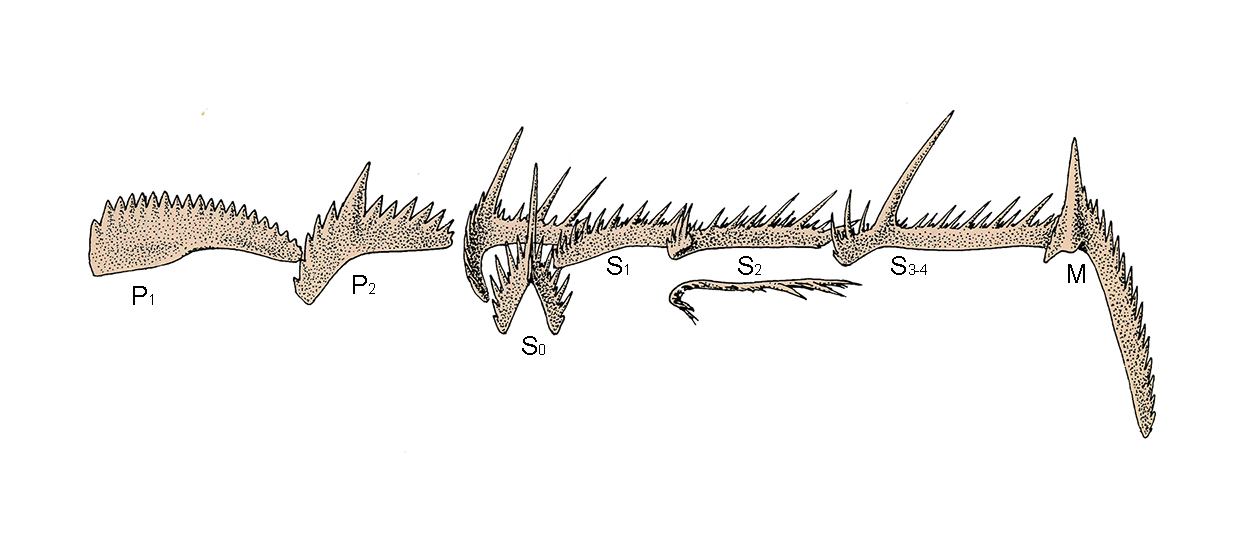
'Pandorinellina' laterigranosa
Sugerowana cytacja: Moczyński 2016. 'Pandorinellina' laterigranosa (Gedik, 1969) . Ikonoteka (http://ikonoteka.paleo.pan.pl/xwiki/bin/viewrev/Species/Pandirinellina+laterigranosa)
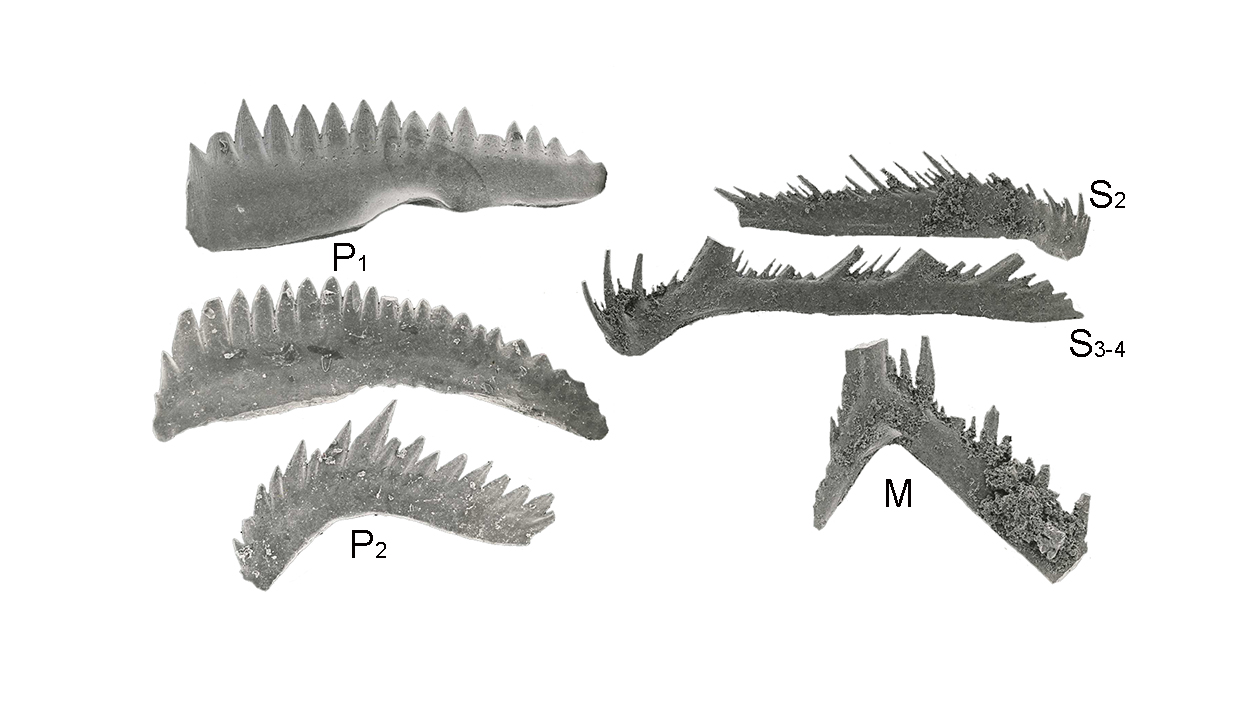 Pandorinellinal laterigranosa - non-platrorm polygnathid from the Tournaisian Wapnica beds of Dzikowiec, Sudetes. Diagnoza The P1 elements show extremely elongated processes with an incipient platform continuing along at least the dorsal process. The true platform never develops, instead, in an adult specimens two strong denticles develop on both sides of the cusp. The P2, S, and M elements are of a very generalised polygnathid type. Porównanie Morphologic distinctions between P2 elements of Weyerognathus, Pseudopolygnathus, Mehlina, and Falcodus are dfficult to specify and it seems that their population variabilities overlap. Autekologia Występowanie geograficzne Carnic Alps, Austria; Dzikowiec, Sudetes, Poland Zasięg czasowy Tournaisian Materiały muzealne ZPAL Literatura Dzik, J. 1997. Emergence and succession of Carboniferous conodont and ammonoid communities in the Polish part of the Variscan sea. Acta Palaeontologica Polonica 42, 57-170. |
|