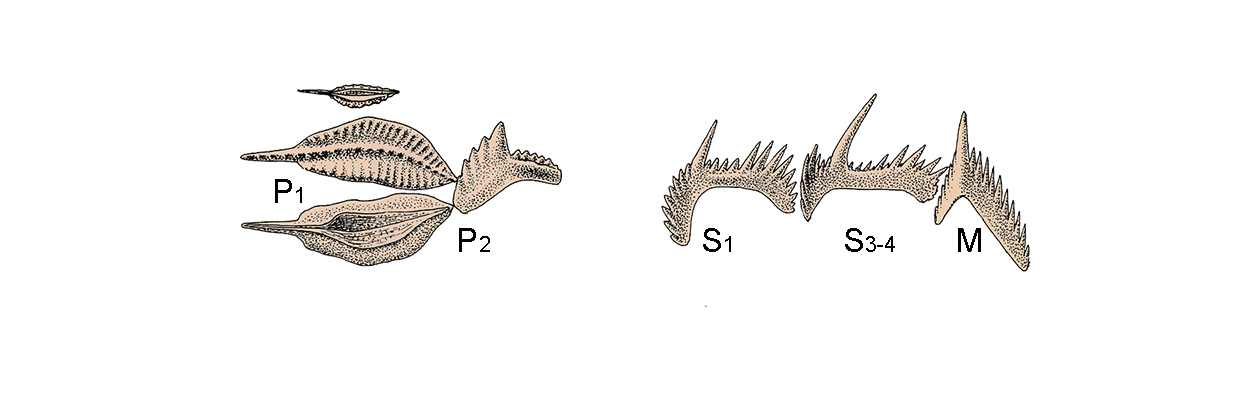
Pinacognathus sulcatus
Sugerowana cytacja: Moczyński 2016. Pinacognathus sulcatus (Huddle, 1934) . Ikonoteka (http://ikonoteka.paleo.pan.pl/xwiki/bin/viewrev/Species/Pinacognathus+sulcatus)
 Pinacognathus sulcatus (Huddle, 1934) from the Tournaisian Wapnica beds of Dzikowiec. Diagnoza The element P1 shows significant variation in the diagnostic curvature, most elements being laterally bent, symmetrical elements not being rare. The basal cavity is also variable in adult specimens being slightly swollen and //Pseudopolygnathus//-like. Porównanie Generally, the basal cavity of P,,1,, elements shows the morphology typical of //Siphonodella//, that is fusiform in shape, but a few very mature specimens are in this respect somewhat transitional to //Pseudopolygnathus//. The only co-occurring oz elements that could belong to the same apparatus are rather robust and variable in morphology. They tend to develop a narrow platform along the dorsal process that gives them a slightly 'notognathella' appearance. Autekologia Występowanie geograficzne Zasięg czasowy early Tournaisian Materiały muzealne ZPAL Literatura Dzik, J. 1997. Emergence and succession of Carboniferous conodont and ammonoid communities in the Polish part of the Variscan sea. //Acta Palaeontologica Polonica// 42, 57-170. |
|